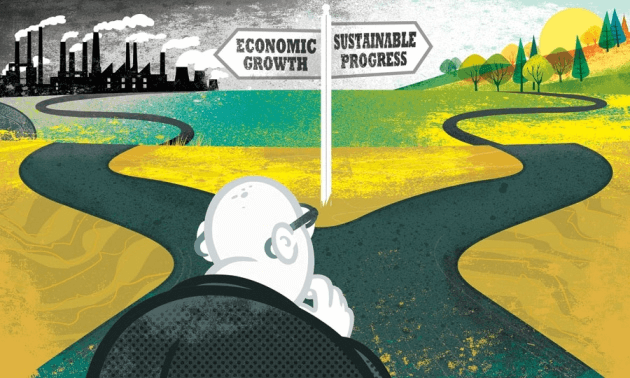
Infinite Growth on a Finite Earth
In the 1950s, economic growth became an overt policy priority for the United States.[1] Still today, Gross Domestic Product (GDP) is how we measure success. A decline in GDP sparks nationwide panic. However, due to the climate crisis, we now have to consider repercussions from the opposite: a growth in GDP.
Data shows that when GDP grows, carbon pollution increases, directly causing global warming.[2] The United States is among the leaders in both GDP and carbon pollution. If the U.S. wants to reduce carbon emissions, we have to consider policies that shrink GDP, or what some policy professionals call economic “degrowth.” However, challenging the American way of doing things is not easy. Economic growth is essential to the United States’ success. At the first international Earth summit in 1992, former U.S. president George H.W. Bush made the United States’ position very clear, “the American way of life is non-negotiable.”
“The American way of life is non-negotiable.”
Renewable energy is now heralded as the answer to carbon pollution and the climate crisis. The U.S. government has its fingers crossed hoping we can continue economic growth without repercussions, this time equipped with solar panels and wind turbines. Part 1 in this blog series demonstrates how dependence on Earth’s raw minerals will prove to be the renewable energy transition’s Achilles heel. The finite availability of raw minerals in the Earth’s crust will not be able to sustain continued economic growth for profit.
Shifting the source of energy from fossil fuels to renewables is like ascending Mt. Everest without enough food supply. Climbing a rock face with ropes instead of a helicopter does not change the harsh reality. The food supply available is still not enough to summit Mt. Everest. Burning fossil fuels in excess is what caused global warming through runaway carbon pollution. Now, with renewable energy, energy corporations will deplete lithium, silver, rare earth elements, and many other mineral reserves through excessive mining and resource extraction.
The energy industry attempts again to climb Mt. Everest by sustaining continuous economic growth with solar panels and wind turbines in place of fossil fuels. Instead, energy corporations must face the harsh reality. It is impossible to summit a mountain of infinite growth.
“It is impossible to summit a mountain of infinite growth.”
Transitioning away from a growth-at-all-costs model is all but inevitable. It is not a question of “if the economy will contract” but when.[4] If we do not intentionally pursue policy towards economic “degrowth,” the contradiction of endlessly pursuing infinite growth on a finite planet will cause economic collapse and climate catastrophe. “Degrowth” policy makes the following case: “perpetual economic growth on a finite planet is impossible and undesirable, and overdeveloped countries need to intentionally pursue strategies that shrink total economic production and consumption to stay within ecological limits and stave off catastrophic climate change.”[5]
So then, within the framework of economic “degrowth,” what can the energy industry do? Below I recommend policy interventions that build towards a sustainable energy future.
Reform energy utilities towards public ownership and not-for-profit operations.

In the U.S., 72% of energy utilities are controlled by private companies and investor-owned utilities. Energy utilities have a notorious history due to their extractive practices driven by profit, low transparency and accountability, and disregard for the climate and natural environment. A public-ownership utility model offers communities more direct access to the energy decision-making process. Democratic decision-making processes will be key to economic “degrowth” by limiting for-profit operations and increasing oversight and accountability.[6]
Invest in mass public transit and reduce personal car use.

“A world crawling with 300-mile range luxury electric sedans requires a lot more lithium, and mining, than a world flush with electric buses.”[7]
Electric cars with lithium batteries will not be the only way to travel without polluting the air. Buses and vans powered by electricity can transport just as many people just as effectively, while using a fraction of the raw minerals.[8] Curbing energy consumption will be a crucial component to successfully achieving economic “degrowth.” Personal car use is remarkably energy inefficient. An improved network of buses can get people out of their Teslas while still getting people where they want to go.
Build recycling programs to reuse minerals from old/used products.

The scarcity of raw minerals forecasts a dire future for energy, but renewables will still be a crucial part of our energy future. Recycling copper, lithium, nickel and cobalt from spent batteries could reduce supply requirements for these minerals by 10%.[9] In 2022, the Battery Recycling Advisory Group in California recommended recycling policies for battery disposal protocol, safe and efficient transport for spent batteries, and universal battery waste regulation.[10] Successful recycling programs will reduce mining and push us towards a more circular and sustainable economy.
Launch popular campaigns to transform energy consumption.

Reduced energy consumption in those parts of the globe that overconsume, such as the United States, will be key to a balanced strategy for economic “degrowth.” A planned increase in consumption for places where poverty leads to underconsumption will ensure that such a radical transformation of the economy is still balanced. However, such a coordinated consumption strategy within a degrowth framework cannot succeed without broad popular support. Popular campaigns to educate the broad public will be crucial to achieving such radical consumption transformation.
In the end, an overhaul of U.S. national policy to shift from economic growth towards economic “degrowth” will involve a broad swathe of solutions, many more than the few examples described here. It is up to us, as a nation and as part of a global society, to re-envision the utility of infinite economic growth while we confront the reality of life on a finite planet.
As the popular phrase goes, “it is easier to imagine the end of the world than the end of capitalism.”[11] Well, now imagination may well become reality. We must decide now to work towards the end of an unsustainable economy doomed to fail before we witness the end of the world through unforgiving climate catastrophe.
[1]Stuart, D., Gunderson, R., & Peterson, B. (2020). Overconsumption as Ideology Implications for Addressing Global Climate Change. Nature and Culture, 15(2), 199–223. https://doi.org/doi:10.3167/nc.2020.150205.
[2] Stuart, D., Gunderson, R., & Peterson, B. (2020).
[3] Stuart, D., Gunderson, R., & Peterson, B. (2020).
[4] Stuart, D., Gunderson, R., & Peterson, B. (2020).
[5] Stuart, D., Gunderson, R., & Peterson, B. (2020).
[6] Climate Justice Alliance. (2017). Just Transition Principles. 1–8. Link.; Baker, S. (2021). Revolutionary Power: An Activist’s Guide to the Energy Transition. Island Press.; Aronoff, K., Battistoni, A., Daniel Aldana Cohen, Riofrancos, T. N., & Klein, N. (2019). A Planet to Win: Why We Need a Green New Deal. Verso.; Saito, K. (2024). Slow Down: The Degrowth Manifesto (B. Bergstrom, Trans.). Astra Publishing House.
[7] Aronoff, K., Battistoni, A., Daniel Aldana Cohen, Riofrancos, T. N., & Klein, N. (2019).
[8] Aronoff, K., Battistoni, A., Daniel Aldana Cohen, Riofrancos, T. N., & Klein, N. (2019).
[9] IEA. (2021). Executive Summary – the Role of Critical Minerals in Clean Energy Transitions – Analysis. IEA. https://www.iea.org/reports/the-role-of-critical-minerals-in-clean-energy-transitions/executive-summary.
[10] Dunn, J. (2022, September 20). California’s Progress Toward Recycling Policy for EV Batteries. The Equation. https://blog.ucsusa.org/jessica-dunn/californias-progress-toward-recycling-policy-for-ev-batteries/.
[11] Jameson, F. (1994). The seeds of time. Columbia University Press.

What’s your email? Stay updated when a new blog post is published!
Thank you for your response. ✨




 UJAY SIDDHARTH
Leave a comment