“Auroville wants to be a universal town where men and women of all countries are able to live in peace and progressive harmony above all creeds, all politics and all nationalities. The purpose of Auroville is to realise human unity.”
– Collected Works of the Mother, page 188 [Auroville Website]
I

I am visiting my ancestral home, Tamil Nadu, a state deep in India’s southern region. When in Tamil Nadu, I visit Chennai, where my grandmother lives. Characteristically urban, Chennai is frenetically alive with bustling people, a cacophony of machine sounds, dust, and car exhaust. It is a typical city in today’s world, energetic with aggressive competition, rife with economic inequality, and heavy with human struggle.
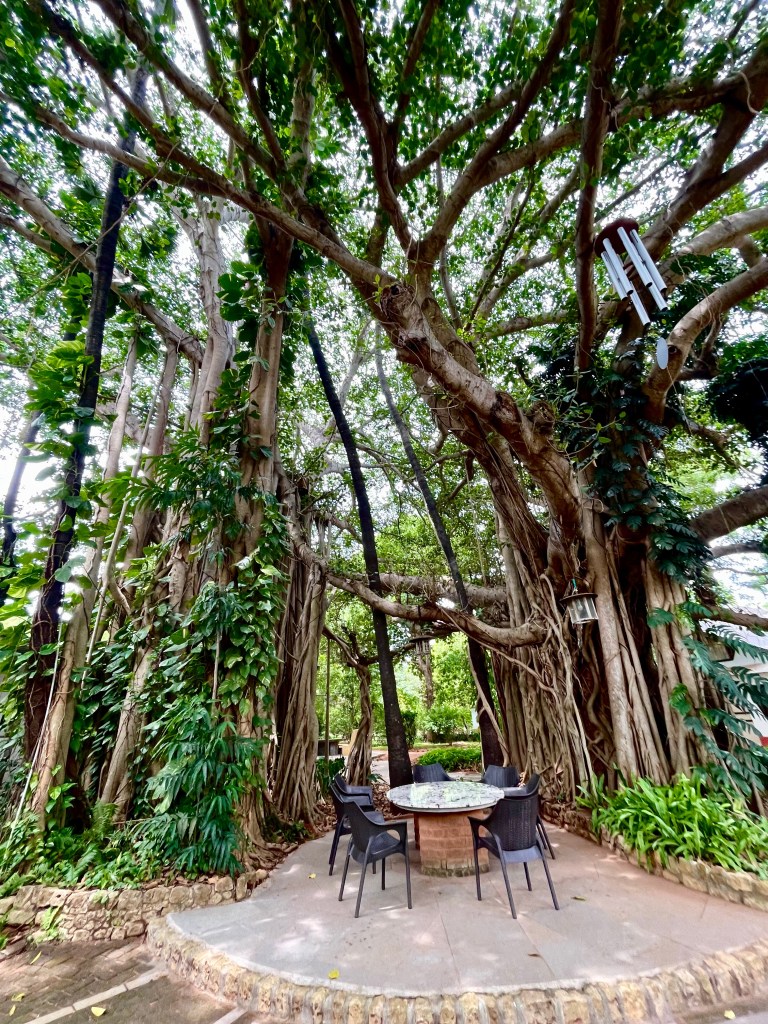
But I write from Auroville, a small town in rural Tamil Nadu. Lush tropical trees and plants overrun the grounds of the guesthouse. I sit under a great banyan tree breathing in the quiet. A soft breeze rustles the tree’s branches and leaves. Those in Auroville want to challenge typical ways of living. Rather than recreate another town rooted in competition, Auroville instead hopes to fulfill its vision to transform human consciousness and realize human unity.
II
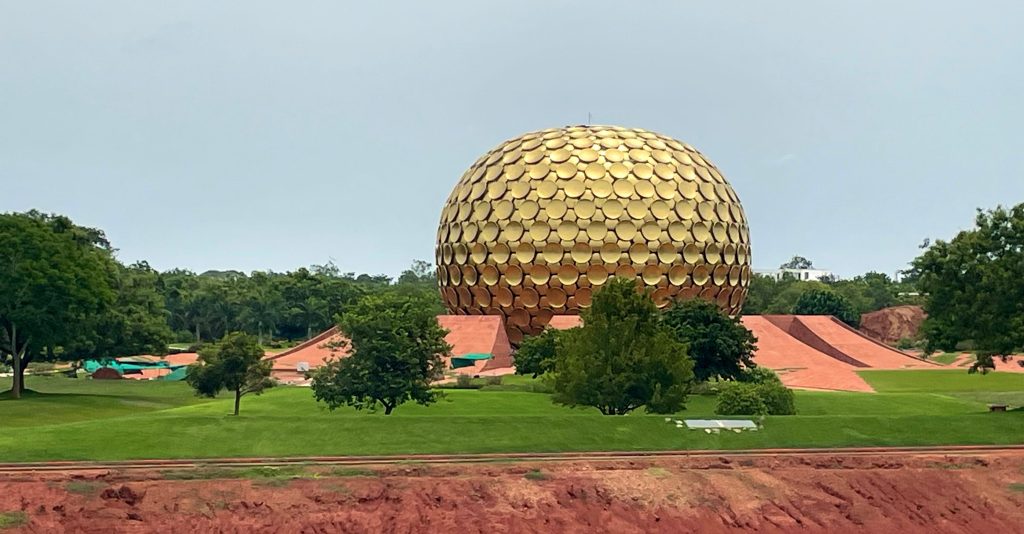
Matrimandir. The crown jewel of Auroville. Cellphones are not permitted. Photography is not allowed. We enter the oval Peace Area walking on red sandstone footpaths. A great banyan tree greets us, ancient and profound. Roots the size of tree trunks grow down from the tree’s branches deep into the soil. Ahead of us, the sphere of Matrimandir covered in gold tiles rises up from the ground like the sun cresting the horizon in the early morning.
To enter Matrimandir, we ascend a red sandstone staircase. The air inside is remarkably cool, a welcome relief from the heat outside. The semi-translucent dome lets soft light in from the sun. Silently we walk in single file on cool marble floors and white carpet. Small candles in glass candleholders light the way ahead.
Soon we arrive at the inner chamber. Silence transcends everything. The chamber is perfectly designed to facilitate contemplation and meditation. Once here, I immediately understand the vision behind Auroville’s founding. I can feel the weight of its remarkable mission to transform human consciousness, develop a collaborative society, and realize human unity.
One by one we walk along the circular edge of the chamber. The floor is covered wall to wall in white carpet. My footsteps make no sound. I silently sit down on a soft white cushion and look around, absorbing it all. The inner chamber is made completely of marble slabs, enclosing us. Twelve free-standing steel columns painted white stand evenly spaced around the chamber like lines on a clock face. A thin column of sunlight beams down from the center of the chamber ceiling illuminating a glass sphere.
I sit there in complete silence. The inner chamber has a gravity I have never felt before. Someone coughs and it reverberates in the room like thunder. I am alone with my thoughts. Some choose to meditate, others simply sit. It is difficult to keep track of time. Time no longer has much significance. The inner chamber is the perfect environment in which to contemplate consciousness.
A light flashes twice. I open my eyes. My time in Matrimandir comes to a close.
III
The town of Auroville is a one-of-a-kind human experiment. Auroville’s hypothesis is that transformation of human consciousness and realization of human unity will be forever intertwined. Residents of Auroville, also known as Aurovillians, work every day to accomplish the vision of Sri Aurobindo and the Mother, who founded Auroville in 1968. Auroville’s crown jewel, a gold sphere referred to as Matrimandir, marks the center of the town. An oval Peace Area encircles Matrimandir with expansive grounds and peaceful gardens. The core purpose and architectural design for the central complex is to facilitate individual silent concentration. “The Matrimandir will be the soul of Auroville. A place… for trying to find one’s consciousness.”[i]
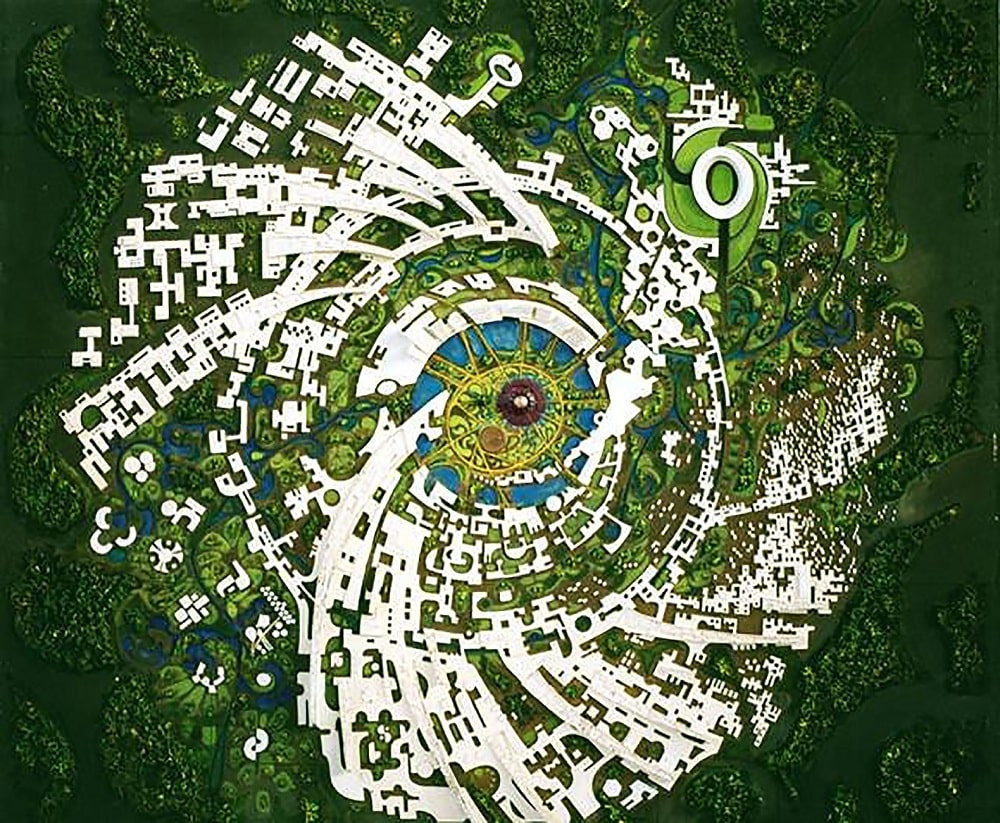
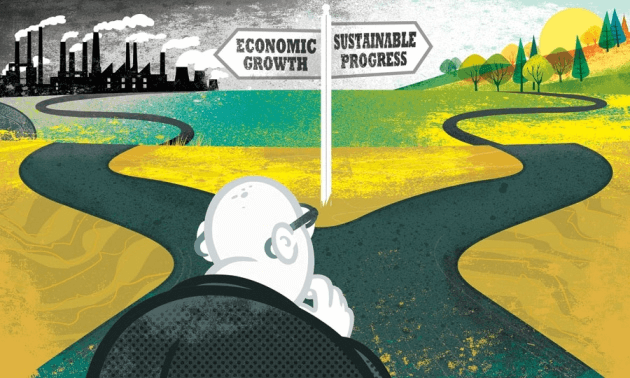
Auroville’s town design starts in Matrimandir’s central complex and spirals outwards into a galaxy shape, the arms of the spiral unwinding into four zones: the Industrial Zone, Cultural Zone, Residential Zone, and International Zone. Each zone serves a core function for the town. At the edge of the town, the final layer for Auroville’s design culminates in a Green Belt. The Green Belt consists of forested areas, farms, and sanctuaries, established to encourage sustainable practices for living. Auroville’s residents maintain the Green Belt for agricultural and forest uses, so that it is not only integrated with existing village settlements, but also with environmental activities that promote water harvesting, aquifer recharge, bio-diversity conservation, and recreation.
During my visit to Auroville, I met with Toine van Megen, who co-founded the Auroville unit Auroville Consulting. He now acts as a mentor and guide to a young and enthusiastic team. In our conversation, Toine emphasizes that Auroville is fully committed to sustainable development, but it is not to be misunderstood as yet another “ecovillage.” He explains that Sri Aurobindo, one of Auroville’s founders, speaks of the human as a “transitional being.” Auroville’s vision is to create an environment in the form of a township for 50,000 residents where the transition to a higher consciousness can be accelerated at both the individual and collective level. Toine firmly believes that we must push beyond sustainability and innovation and instead create urban environments and spaces that induce transformation.
IV
I learned many lessons on urban planning in Auroville. Here are three of them.

Urban Policy Should Encourage Collective Ownership
Since its founding, Auroville has been unafraid to explore alternative models for development and land use. Many lessons can be drawn from its town planning policies. For example, Auroville’s land system functions similarly to a community land trust. All lands and buildings are under the legal ownership of Auroville Foundation. Residents can contribute to the construction of a house or other building but do not own the building or the land. Through this process, Auroville delinks usage from ownership and makes housing affordable by taking it out of the speculative real estate market and eliminating the cost of the land underneath it.
In my conversation with Toine van Megen, he explained to me that a sustainable energy future for Auroville must include systems for distributed renewable energy generation and energy storage. Auroville has installed solar systems inside the town and wind turbines in windy areas elsewhere in Tamil Nadu. With this energy, Auroville already produces a surplus of renewable energy beyond what its own residents consume. For many decades now, Auroville has attentively worked to address the collective energy consumption of its local township through renewable energy.
Auroville has many policies focused on collective ownership when it comes to land, economy, energy, agriculture, and other forms of governance. Here in the U.S., restructuring urban policy to address collective needs, and perhaps even learning from Auroville, could help solve many of the problems that plague American cities today.

Public Space Design Should Support Spiritual Practice
Auroville does an excellent job designing the town and its public spaces to facilitate the pursuit of spiritual practice. Look no further than the town’s central meditation sphere! Now back in the U.S., I hope to draw lessons from Auroville’s town design to support meditation, spiritual practice, and the exploration of human consciousness in my city’s own urban spaces.
Urban planners can intentionally design public spaces to encourage meditation and quiet reflection. Small areas of refuge and clear signage can indicate a space is meant for spiritual practice. Natural features can evoke a sense of serenity and strengthen our connection with the living and breathing world. A sense of sanctuary can encourage people of all denominations to pursue their own spiritual practice without interruption. Done mindfully, public space design can create safe spaces for people to pursue spiritual practice and engage in individual reflection.

Transformation of Human Consciousness and Realization of Human Unity Will Be Forever Intertwined
I learned perhaps my most important lesson during my conversation with Lalit Kishor Bhati. Since 1998, he has worked in Auroville as an architect and planner. The mission of his architecture and planning studio, PATH studio, describes his life philosophy well. PATH studio’s work centers on the belief that “beauty and harmony in the built environment inspires corresponding harmony and wellbeing in life.”[ii]
In my conversation with Lalit, I had a curious experience. I arrived at our meeting with many questions about urban development, about climate change, about growth, about sustainability. To all my questions, he had one answer: “the transformation of human consciousness.” As our conversation progressed, all my prepared questions started to feel more and more secondary. For Lalit, the primary way to act is to engage with his consciousness and act from there as an architect, a planner, a father, a husband.
Throughout our conversation, I had to respect his doggedness to drive home his message. For Aurovillians, the truest way to act when striving for human unity is to begin from a deeper place inside ourselves. Outside of Auroville, those who control society chase external things: power, status, money. The experiment in Auroville flips the script on them. Aurovillians believe that searching internally within our consciousness and continually working on our own minds and bodies will forever be essential to achieving peace, harmony, and human unity.
There is no doubt, urban development, climate change, growth, and sustainability are all issues of ever-increasing concern. However, realizing a society that benefits all is not possible without also the internal work on ourselves to be good people.

[i] https://auroville.org/page/matrimandir-and-peace-area
[ii] https://pathstudio.auroville.org/about

What’s your email? Stay updated when a new blog post is published!
Thank you for your response. ✨



 UJAY SIDDHARTH
Leave a comment