
Waymo’s white SUVs, silent except for whirring cameras, cruise every inch of San Francisco, even granted VIP access to car-free Market Street. On June 25th, 2024, exactly one year ago, San Francisco gave Waymo the authority to operate city-wide. Within its inaugural year, Waymo overtook Lyft to become the second most popular ride-hailing service in the city. Waymo, once just a fun conversation starter, is now on the cusp of a commanding takeover of the taxicab business.
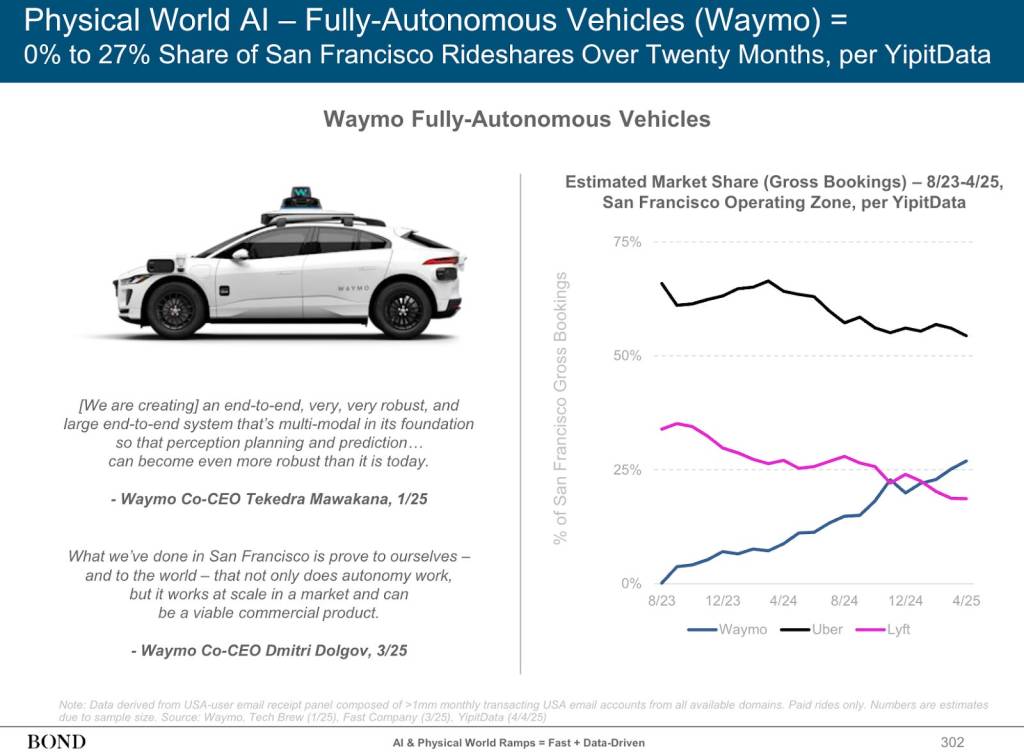
The driverless Waymo taxi boasts eight cameras and an omnidirectional LIDAR system. Cutting edge technology reflects lasers off its surroundings to help the car “see” and safely navigate San Francisco without human supervision. What the Waymo taxi still can’t do is critically assess its widespread adoption and rippling impacts on jobs, climate change, and everyday people. That job cannot be automated yet, thankfully, and is still left up to us.
How will widespread adoption of driverless technology impact jobs, climate change, and everyday people? I don’t have all the answers, but I took a stab at debunking two widespread myths.
MYTH #1
Driverless technology will be good for the economy because it will grow profits for taxicab companies, delivery companies, and trucking companies.
By 2030, costs for driverless rides could be cut by more than half, far outcompeting costs for rides today with Uber and Lyft. The price tag for autonomous driving technology, $100,000 in 2014, is expected to drop as low as $3,000 by 2035. For the trucking industry, autonomous technology can already complete tasks in half the time it would take a human truck driver. In 2022, an autonomous truck worked 24 hours per day without rest shuttling goods between Dallas and Atlanta. The truck traveled 6,300 miles delivering eight loads in five days. To accomplish the same feat, a human driver would need twice as much time. People have to sleep, eat food, and maintain good mental health, all of which costs companies valuable time and money.

Driverless technology will be bad for the economy because it will push many workers out of jobs in a society without a good safety net to support them.
A report on autonomous vehicles predicts at least four million driving jobs could be lost in the transition. For rideshare companies and trucking companies, it’s a no-brainer. A chance to replace people with automated computers is like striking gold. The American Transportation Research Institute found that the industry pays 44% of its total costs towards wages and benefits for drivers. For companies that take advantage of automation, drastically cutting down labor costs is a surefire pathway towards tremendous profit.
Once drivers lose their jobs, they will need to find new ones. A top concern in the industry is that replacement jobs may offer less pay and require developing new skills or moving to distant locations. Brandon Dawkins, Vice President of Organizing at SEIU, strongly criticizes the trajectory of the labor market in California. He asserts that the current policy landscape “overlooks the immediate welfare of ride-share and delivery drivers who heavily rely on these jobs for their livelihoods.” To companies that benefit from automation, four million jobs lost is simply collateral damage in the pursuit of financial gain.

MYTH #2
New technological advances in cars and trucks such as driverless technology and electric batteries will save carbon emissions and reduce climate impacts.
Waymo saves carbon emissions through its fully electric fleet of driverless cars. Every 200,000 trips in a Waymo taxi prevents 250 tons of carbon from polluting the air. In 2023, a study by the Coalition for Reimagined Mobility in San Francisco found that if just 6.6% of cars were replaced with electric AVs, fine particulate matter concentrations would decrease by an estimated 40%. Driverless cars are also more efficient than humans drivers—especially in acceleration and braking, which results in lower energy consumption per mile.
New technological advances in cars and trucks such as driverless technology and electric batteries will encourage people to drive more which will escalate energy demand and increase climate impacts.
First, driverless technology will take over taxicabs and trucks. Next, companies will install driverless technology right into your car. Research has already tried to predict how driverless cars will impact driving behavior. One study surveyed 630 Tesla owners with and without Autopilot, an advanced driving-assistance feature. The survey found that Tesla drivers with the Autopilot feature drove close to 5,000 miles on average more each year! A second study mimicked automation by granting research subjects with a chauffeur to drive them wherever they wanted for one week. Compared to the week before when they had no chauffeur, research subjects drove a whopping 83% miles more! While driverless cars will save carbon emissions, we must also consider how automation will change the way people drive. Growth in individual car use will only demand more and more energy. Continuing to satisfy higher demand for energy, through renewables or otherwise, will challenge our ability to build an ecologically sustainable future.
The shockingly steep rise of Waymo in San Francisco is a sign of a broader phenomenon: AI. An industry expert – the CEO of Anthropic, one of the world’s most powerful creators of artificial intelligence – predicts that “AI could wipe out half of all entry-level white collar jobs and spike unemployment to 10-20% in the next one to five years.” Not only does AI threaten labor markets, AI technologies also demand more energy. The global adoption of driverless technology would generate an additional 0.14 gigatons of carbon emissions each year—as much as the nation of Argentina. And that’s just driverless technology on its own.
During the rallies against ICE raids, protestors stalled a Waymo car in downtown San Francisco and spray-painted the message “People Over Profits.” That single phrase captures the crux of the issue. Companies adopt driverless technology to reduce their need for workers in the pursuit of financial gain. We must reverse the relationship and put people first ahead of profits. We can do that by implementing people-first programs such as unemployment insurance and job training for displaced workers, a tax on automation technologies with funds directed to stabilize the labor market, and investments in public transit that reduce reliance on personal car use.
Driverless cars such as Waymo taxis will have a place in our future. However, controlled implementation is crucial. Otherwise, driverless technology will follow a familiar playbook already set out by other AI technologies. Many workers will be pushed out of jobs, driving and personal car use will escalate, and energy demand will soar. Waymo, driverless technology, and AI must be well-regulated if we want to build a future that works for all people.

What’s your email? Stay updated when a new blog post is published!




 UJAY SIDDHARTH
Leave a reply to sshankarwriter Cancel reply